Sunday, September 9, 2012

Just Another Day


The dog days of summer are behind us, but days do seem long. Pain has been absent from my life lately, for which I am grateful, but fatigue has taken its place. I pull  myself from chore to chore trying to enjoy the day, sometimes succeeding, sometimes falling asleep, sometimes just not caring about it much. Life is still good though, because I know it will not always be this way. God is still on the throne and His mercies really are new every morning.

This day, we had to dispatch the 12 game roosters that came as “packing material” when the hatchery shipped the meaties to us. They grew up to be truly ugly and flighty birds without much meat on them. I was hoping to save the breasts for canning, but their purpose will be better served as sustenance for the dogs. Randyman heads off to work so I begin harvesting chickens. I get through 3 of them before I am too tired to go on.
I head back to the house with Cider after gifting a bird each to the ‘polar bears’ who have done such a beautiful job protecting all the stock. After securing their treasures, they both come to the house for a nap inside the cool, dark living room. There aren’t many windows in this house and the light shines dimly across the kitchen.

I choose to work on my grandaughter’s birthday clothes. It’s not a birthday ‘suit’, as she, naturally already has one of those. One outfit, requested by her mom, needs eyelet lace which I forgot to buy on our trip to town, so I ordered 3 yds online. It came and I see that I got the wrong size. It will have to be set aside until we go to town again next week. I begin again on another outfit only to find the seam binding I was SURE I had purchased, is nowhere to be found. I dig around in my patterns and fabric piles to look for yet a THIRD choice.

Randyman shows up for lunch and I pull out what is left of the Claypot chicken from last night’s dinner. The meat birds were such a good investment. The flavor and the amount of meat on them has been a boon for us. I wish I had known about them years ago. 34 isn’t going to be nearly enough to get us thru the year. I wish we had room for one more freezer, of just chicken...maybe some other time. I grab some pepperjack, tortillas and Cholula and make a couple of quick and tasty quesadillas. We scarf them down and I put the rest of the leftover meat back in the fridge for later.

I had pulled out the 50 lb bucket of hard white wheat berries and milled them earlier, putting the flour in to soak with some fresh buttermilk, courtesy of EmmaLou Moo. I grab the jar of sourdough starter I had fed earlier and put it all together and make a round of bread. I’ve not been as constructive this week as usual, do to the lack of energy, but I did manage to make some fettucini noodles for the first time using the pasta press I had finally ordered. They came out fantastic and even Randyman said they were perfect. That’s a big deal for a guy who never has an opinion.


A couple of hours later, Randy shows up and asks if I want to go with him to fix an irrigation pipe. I grab my camera, just in case, and climb up in his work truck.

Leaving Cider home with the polar bears, we head down the ranch road to where he goes to work fixing the water problem while Scotty, his dog, bounces around watching.


Afterwards we head down the public road, which is 50 miles of dirt and gravel from the ranch to the first pavement. It’s fall now, and the 750 pair that had been pushed up to the top of the mountain are on their way home. The ranch cowboys spent a week up there gathering them and pushing them down the long, steep, winding path to the valley floor where they are left to wander the 10 miles back to the ranch at their own pace. I always find it interesting that they remember where to go, traveling these great distances from the desert permit back to the ranch, or from the top of the mountain and down the long road thru the valley back home.


We pass 15 pairs but as we approach the cattle guard we notice a cow in the middle of the road that isn’t moving. With a groan we see she has walked into the cattle guard and gotten both front legs stuck thru the pipes. It’s obvious she has been there for quite some time as she is drawn up and both legs are swollen and a lot of the hide has been rubbed off from her efforts to free herself. There is a set of tracks where someone, a tourist most likely, drove around her and continued on their way without bothering to let anyone know there was an animal trapped and needing help out on the road. This is just another confirmation of why I am glad we live where there aren’t many people. So few leave a favorable impression on me.


Seriously...could you just leave her there and keep driving? These are probably the kind of folks that say we are cruel for roping the cows so we can doctor them. My experience has been that most of them people are uninformed, with tunnel vision. Am I ranting?

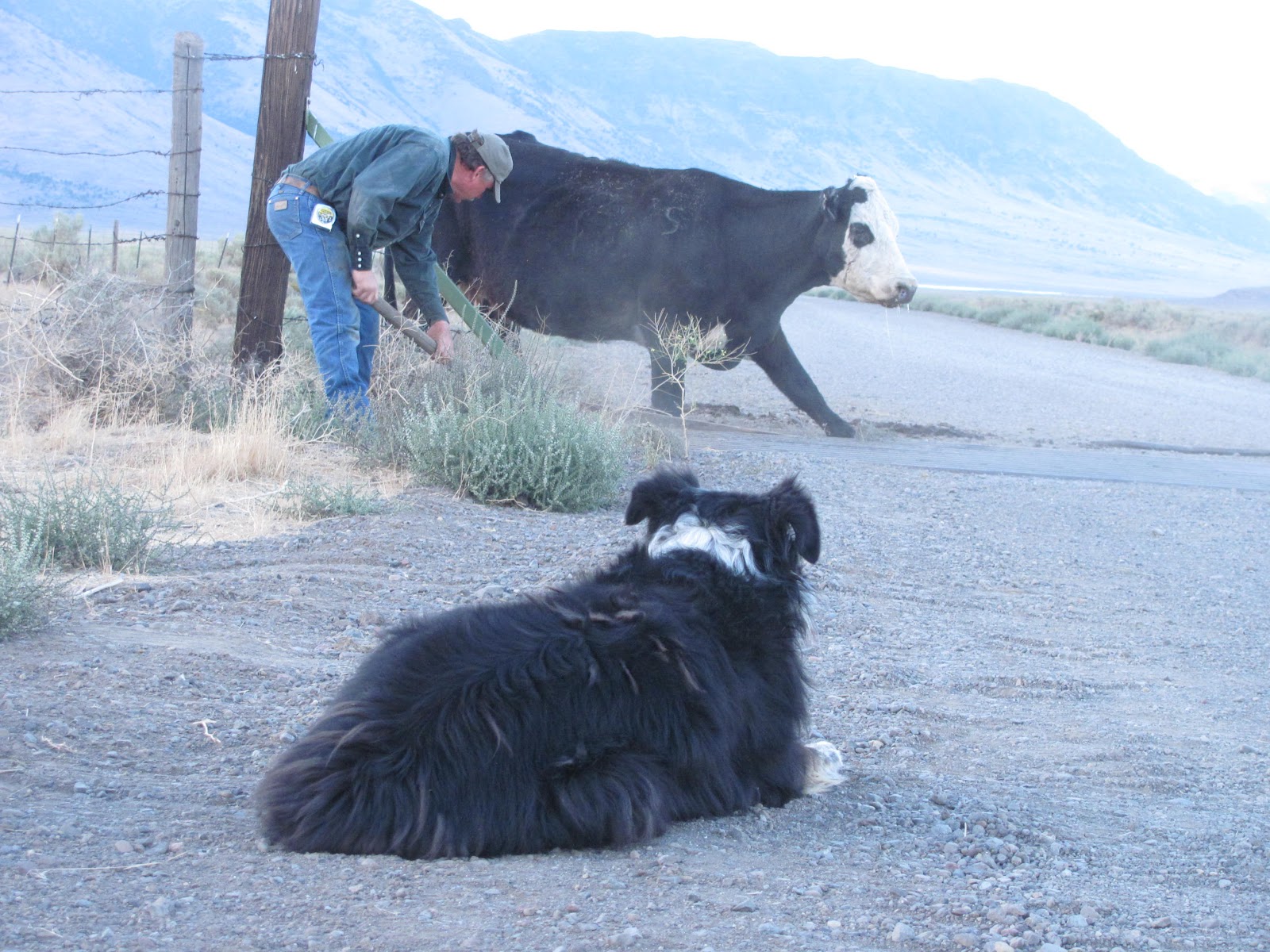


Randy tries to free her but it can’t be done. He calls the boss who jumps in a truck and heads out to join him in freeing her. He shows up after about 15 minutes and grabs several fence posts out of his truck, placing them between the bars of the cattle guard  as a bridge, in case she tries to go forward after being freed and prevent her putting a leg through again. After looking the situation over, they decide the only option is to cut her out. Randyman grabs the welding torch and sets about cutting a notch out of the pipe while the boss does his best to keep her head and legs pushed as far away from the work as her situation will allow.


He sends me to his truck for a gatorade, which he then pours on the hot pipe to cool it before they try pushing her legs over to the notch. The liquid steams into small clouds, rising from the cattle guard as the red hot steel slowly cools. Between them, they finally manage to pull one foot free. She promptly jerks it over next to her other leg and jams it through the pipe again.


Groaning, they go to work restraining and cutting once more. Sparks fly and dry mustard weed, under and next to, the cattle guard and cow erupt into a blaze. The boss asks me to grab a shovel and I begin putting out the small fire while they continue their work, focused only on freeing her.


Finally the job is done. The cow is free, we are all relieved and she heads on down the road, far behind the others, while we all head for home.

There are calves to feed, and goats, sheep and horses to take care of, along with EmmaLouMoo and Sushi, before dinner is made.

Another day is almost done.


Saturday, September 1, 2012

Lessons from the Funny Farm


Things we can learn from critters...


Sometimes we should make an effort to fit in...


Find friends of like mind...


 beware of wolves in sheep's clothing...


Don't discount the value of therapy...


Sleeplessness can often be remedied by counting sheep...


Go where you feel accepted...


Be kind to door to door salesmen


Try not to bore others with too many details...


Hiding from your fears won't make them go away...


Don't let rejection by others define you, to be an individual you don't have to follow the crowd...


Remember that you just can't please some people...


Don't be afraid to climb higher to reach for your dreams...


Choose good role models...


Don't be afraid to apologize when you are wrong...


Be content with what you have...


Don't judge someone by how they look


Have compassion for others, even if they are different than you


Color doesn't count, but character does


Wednesday, August 29, 2012

A Little Education and A Phone Call

I am going to break tradition a little bit here to ask those of you out there to help, by making some phone calls...well, actually just ONE phone call.

My youngest son is a hunting guide by profession and several times has been asked by Wildlife Management to assist in what is known as a 'depradation hunt'. That means that an animal which is endangering folk has to be trapped or harvested. This more often than not, has to be done using dogs. Dogs are an essential element in safely and humanely researching and managing wildlife.

California, which often leads the rest of the nation, is trying to pass a bill to ban ALL hunting with dogs. People who have not participated in this have a very wrong idea of what this is all about. It is not a cruel or inhumane blood sport.
Following is a letter I think will help better than anything else to help you understand better. This has been taken from http://www.ussportsmen.org/cms/wp-content/uploads/2012/08/8-29-12Whats-Right-About-Hound-Hunting-1-Pager.pdf


What􏰀s Right About Hunting With Hounds:
By Josh Brones, President of California Houndsmen for Conservation
Senate Bill 1221 would ban the use of hounds to hunt bobcats and bears in California. The sponsors of SB 1221 allege that the use of hounds is inhumane, unsporting and unfair. Unfortunately, the information they use to support this bill comes from anti-hunting organizations that have no motivation to be truthful about the practice.
I have raised, trained, and hunted with hounds since 1986, and I believe it is critically important for legislators, the media, and the public to hear from people who actually hunt with hounds in order to truly understand and appreciate the many aspects of this time-honored tradition.
Here are 10 facts about hound hunting:
1. Hound hunting has been legal since the inception of the California Department of Fish and Game, and is relied upon to help meet management goals. The Department􏰀s own environmental impact documents consistently indicate that the use of dogs and radio telemetry collars does not threaten the survival or prosperity of our bear population. In fact, California􏰀s bear population has nearly quadrupled over the past thirty years...all while the use of hounds has been permitted.
2. Hound hunting is virtually the only form of non-consumptive hunting, and is very similar to catch-and-release fishing. The ultimate goal of using hounds is not the harvest of wildlife, but the enjoyment gained in training, listening to, and interacting with the dogs during the pursuit. As such, hound hunters often take fewer animals than is prescribed by the Department on an annual basis.
3. Hound hunting is a highly effective form of wildlife management. It allows an animal􏰀s age and sex to be determined before any attempt to harvest is made. It also allows a houndsman to determine if a female is pregnant, nursing, or has offspring so that they can be left alive and well in the tree.
4. If a hunter would like to take the animal for food, the close range of the treed bear allows the hunter to ensure that the harvest of the animal is very quick and humane.
5. Radio telemetry equipment is used to promote the welfare of the hound and does so primarily when the dog is no longer pursuing the bear. The equipment does not enhance the hound􏰀s ability to catch up to the bear, nor does it hinder the bear􏰀s ability to evade the hound...it simply allows the hunter to find his hound in deep canyons or mountainous terrain, or prevent the hound from entering into private property or upon highways. The use of radio telemetry would only be unfair if the radio telemetry collar was put on the bear, but clearly, that is not the case.
6. The use of hounds is a primary means of facilitating wildlife research. In fact, hounds are used in every one of the mountain lion studies currently being conducted in California. This is due to the fact that the use of hounds is an effective, stress-free, and minimally invasive way of capturing mountain lions so as to collect samples and fit them with radio telemetry and GPS collars.
7. The use of hounds is one of the most fundamental forms of hunting and can be boiled down to the houndsman, the dog, and the animal they are pursuing. The relationship between bears and hounds can be traced back to the origins of both species. The bear may decide to climb a tree, but it does so only because the instincts and physiology developed from its ancestors' interaction with the hound's ancestor motivates it to; this interaction is not stressful or harmful to the bear, and many bears fall asleep in the tree while they wait for the houndsman to come get their dogs so that the bear can go about its business.
8. The use of hounds for the hunting of bear and bobcat requires specially bred dogs, a tremendous amount of time and training for the hound and hunter, and an extensive amount of dedication and sacrifice on the part of the hunter. It is not a lifestyle to be entered into without an abundance of deliberation, nor is it an activity that is easy or without challenge. Any success with hounds must come as the result of countless generations of careful breeding of the hound and a lifetime spent learning about hounds and wildlife on the part of the hunter.
page1image36584
9. Our hounds are very much like family. In addition to the culmination of effort and money that they represent, the time we spend with them and the memories we share forge a bond that is very difficult to describe. The relationship between hounds and their hunters is similar to that of a parent and their child because we are often there when they are born, we name them, we raise them, we remember all of their milestones during their growth, we beam with pride when they have done well, we worry about them if they are lost, and we cry like babies when they pass on.
10. The use of hounds allows for the timely and accurate resolution of incidents involving threats to public safety or livestock by identifying, locating, and taking only the offending animal. 

You do not have to be a California resident to make this call, as it will affect all of us.
Please take the time to call (916) 445-2841 and Press 1 for english, then press 6 to talk to a rep. Very easy and just takes a second. Ask to Veto SB1221.

Let our grandkids grow up enjoying the same experiences we and our famiies got to, and help Game management do their job efficiently, for the sake of the wildlife.

I have disabled comments on this blog, as I am not looking for feedback, this is merely a request for action.
Thanks for reading and thank you personally, from my family and I to those who take the time to make the necessary call.

Saturday, August 25, 2012

Tastes Like Chicken-Raising our CornishX


Every year now, we raise ‘meatie’ chickens. These are CornishX  like you see in the grocery store, only they are NOTHING like the ones you buy. They are the same hybrid birds, but must be purchased as chicks, as they have been over 50 years in development and the big companies, such as Tyson’s, have a patent on them. But we can order day old chicks from hatcheries so that is what we do. These birds grow AMAZINGLY fast, from day old to table in 8 weeks.

They eat an inordinate amount of food and are known to have many problems due to their rapid growth and weight gain. Often they will, quite literally, eat themselves to death. They often suffer from heart problems and leg problems. They rarely survive over 12 weeks of age, many dying younger. A lot of people don’t like raising them because of their health problems and because...well, anything that eats constantly also poops constantly and they are a bit stinky, when cooped up.

Knowing they will not normally survive beyond 8-12 weeks makes processing them a  whole lot easier for me, of course, as I am not actually hastening their demise.  Our technique in raising them is a bit different than most, because of the Maremma Guardian Dogs we have. The first 3 weeks, the chicks stay in a brooder outside, under heat lamps. We started with 34 this spring.


 They have their food taken away at night and are checked daily for ‘pasty butt’ or other problems. They get ACV (apple cider vinegar) in their water and occasionally some hard boiled egg or other stuff which seems to help them out. Their brooder is cleaned daily with fresh shavings added back. Once they are 3 weeks old, they have feathered out enough and gotten big enough to move to their next quarters.


Assuming all the lambs have arrived and goats have finished kidding, we catch the meaties a few at a time and put them in a  big wheelbarrow for transport to the lambing shed. They get to spend a few days in there until they accept it as their ‘safe place’. After that, the gate is left open and they have access to the back yard. They do all their eating and drinking outside and the Maremma’s protect them from raptors and other predators. We used to have Great Horned Owls landing on top of the chicken coop at night, terrorizing and stalking the poultry, but since Bruno and Cletus came, they don’t  anymore, even though we can see the owls staring at us from in the barn. The dogs have been amazingly effective. 


This allows the meaties to free range at will, coming and going as they please, a much better option for us, than putting them in a ‘chicken tractor’. They are cleaner and get more exercise. With fresh grass and bugs to eat, the meaties are rationed only enough food to get them out of our way when we go to feed calves in the morning, and again at night. They learn pretty quickly that seeing me go outside usually means treats. They pretty much mob anyone daring to enter the back yard, waddling at high speeds to weave and bob between our legs as we walk. The free ranging made it a lot more economical to raise them, as well as healthier for them. The food they do get, is a high protein grower ration, to make sure their needs are met, but the bulk of their diet they forage for.

This year, we started with 34 meaties and ended up with 32. Not a bad record. 


The favorite meatie hangout this year was under the raspberry bushes by the rock wall. There was ample shade and moisture there to help them keep cool in the hottest part of the day. 


They ventured into the flower and veggie gardens when it cooled off and did a great job of keeping bugs away from the plants. This year there were 0 tomato hornworms and until the meaties were gone, there were no squash bugs. They were either not interested, or unable to keep up with the massive infestationof box elder bugs we get every year, but those didn’t attack my plants.

They spent their spare time begging for handouts from whomever dared venture into their territory.


Abby found it all highly amusing!


They had a great life, with all the room to roam they could want, protection, food and comfort. In the end, they were dispatched with respect and compassion in our efforts to make it as humane and easy as possible.

Sometimes folks ask me how we have the heart to raise our own meat. The chickens purchased in commercial stores have been raised in crowded conditions, usually in filth and without fresh air or sunshine.

photo from internet


 It wouldn’t take long to do a study on that to find how horrible the conditions are that most of these animals are raised in. Their end is no better. Our animals live a healthy, happy life, in as natural an environment as possible. Their needs are all taken care of and they are treated well and appreciated. The end of their life is well considered. Instead of dying a painful death of illness or old age, or the more common death  being torn apart by a predator, they are given a quick and nearly painless end, with purpose. I would much rather be one of my own chickens or sheep than a wild animal, or much, much worse, one raised in captivity by commercial farms. We know how they were raised, treated, fed and processed, all with the highest quality of care. We appreciate our meals more also, knowing where it came from and the cost to the animal. You just can't take that for granted like you can when you buy it at the store.

This year we invested in a WhizBang Chicken plucker. The hardest part of processing chickens is the plucking. It would take forever for me to get all the feathers out and with some of the older birds, I would get so discouraged, I would give up and donate it to the dogs, who would take it out to the pasture and guard it for a few days, as if holding a little wake, before they finally, with clean consciences, consumed it. Being able to process our own chickens gives  us the flexibility to decide WHEN is the best time, plus it saves us over $3 per bird plus the fuel it takes to drive over 200 miles to have it done. 

As we had 30 birds to do, we broke it down into 2 days. I put the first 15 in the shed for the night and locked them in, so we didn’t have to chase them around the next day and also so their crops would be empty. It’s a lot more sanitary and easier to do if they haven’t eaten for 8-12 hours. They do get all the water they want though. The first day took us a few hours as we were still getting the hang of things. The second day went much smoother and faster.

We used a traffic cone to put the birds in to dispatch them and bleed them out. They then went into a scalder, which was a turkey fryer full of water kept at about 145-150 degrees. Once the feathers came off the wing easily, two at a time were put in the plucker and about 45 seconds later they were completely clean. They then went to the table where we cleaned out the insides and finished them and put them into a large cooler full of ice water, to quickly chill.


Keeping the water cold, we let them sit overnight, the next morning we bag them and put them in the fridge for a day or so until the rigor mortis is gone and the joints move freely. If you don’t, the meat will be inedible. 

At that point we will freeze them. All the feet go in the freezer until I have time to ‘take their socks off’ and use them to make stock along with left over  vegetables and carcasses from meals.

All our birds this year weighed over 5 lbs and a few over 6. The meat is incredible.

I cut up one chicken into parts. The legs, thighs and wings went in the frying pan for one meal as fried chicken . One breast I cut up  for chicken strips for another meal a couple nights later. The other breast I cooked up to use in a chicken divan casserole and the back was put back into the freezer to use in stock. That’s a lot of mileage out of one chicken! The flavor and texture of these birds is also superior to anything you can buy, and there are no additives or preservatives put in them. They were healthier than commercial birds and we will have healthier benefits from eating them!

Now THAT is something to crow about.